


PWM, or Pulse Width Modulation, is a pretty nifty technique that plays a crucial role in motor voltage regulators. As a supplier of motor voltage regulators, I've seen firsthand how PWM can make a big difference in how motors perform. So, let's dive into how PWM works in a motor voltage regulator.
The Basics of PWM
At its core, PWM is all about controlling the average power delivered to a load - in this case, a motor - by varying the width of the pulses in a pulse train. Think of it like turning a light on and off really fast. If you turn it on for a short time and off for a long time, the light will appear dimmer. If you turn it on for a longer time and off for a shorter time, it'll be brighter. That's the basic idea behind PWM.
In a motor voltage regulator, we use PWM to control the amount of voltage that reaches the motor. Instead of providing a constant voltage, we send a series of pulses. The voltage is either at its maximum value (when the pulse is "on") or at zero (when the pulse is "off"). By adjusting the ratio of the on - time to the total period of the pulse (known as the duty cycle), we can control the average voltage that the motor receives.
How PWM Affects Motor Speed
One of the main reasons we use PWM in motor voltage regulators is to control the speed of the motor. You see, the speed of a DC motor is directly related to the voltage applied to it. The higher the voltage, the faster the motor spins.
With PWM, we can vary the average voltage without changing the actual amplitude of the supply voltage. For example, if we have a 12 - volt power supply and we set the duty cycle to 50%, the average voltage across the motor will be 6 volts (because half of the time the voltage is 12 volts and half of the time it's 0 volts). As we increase the duty cycle, the average voltage goes up, and so does the motor speed. Conversely, decreasing the duty cycle reduces the average voltage and slows down the motor.

PWM and Motor Torque
It's not just about speed, though. PWM also has an impact on the torque of the motor. Torque is what allows the motor to do work, like moving a heavy load. When we use PWM, the current flowing through the motor also changes in a pulsed manner.
During the on - time of the pulse, current starts to flow through the motor windings. As the current builds up, it creates a magnetic field that generates torque. When the pulse goes off, the current decays, but the motor's inertia keeps it spinning. By adjusting the duty cycle, we can control the average current flowing through the motor, which in turn affects the average torque.
Components in a PWM - Based Motor Voltage Regulator
A typical PWM - based motor voltage regulator consists of a few key components. First, there's a power supply, which provides the raw electrical energy. Then, we have a PWM controller. This is the brain of the operation. It generates the pulse train with the desired duty cycle.
Next, we need a switching device, like a MOSFET or an IGBT. These devices are used to turn the power on and off at the rate determined by the PWM controller. They act like high - speed switches that connect and disconnect the motor from the power supply.
Finally, there are usually some filtering components, like capacitors and inductors. These help to smooth out the pulsed voltage and current, reducing electrical noise and protecting the motor from sudden voltage spikes.
Advantages of Using PWM in Motor Voltage Regulators
There are several advantages to using PWM in motor voltage regulators. First off, it's very efficient. Since the switching devices are either fully on or fully off most of the time, there's very little power loss in the form of heat. This means that more of the electrical energy from the power supply is actually used to drive the motor.
Another advantage is flexibility. We can easily adjust the duty cycle to control the motor speed and torque over a wide range. This makes PWM - based motor voltage regulators suitable for a variety of applications, from small hobby motors to large industrial motors.
Different Types of PWM Techniques
There are a few different ways to implement PWM in a motor voltage regulator. One common method is called "trailing - edge modulation". In this technique, the on - time of the pulse starts at the beginning of the period, and the off - time is adjusted by changing the end point of the pulse.
Another method is "leading - edge modulation", where the off - time starts at the beginning of the period, and the on - time is adjusted by changing the start point of the pulse. There's also "center - aligned modulation", which is a bit more complex but can offer better performance in some situations.
Real - World Applications
As a motor voltage regulator supplier, I've seen PWM being used in all sorts of real - world applications. In robotics, for example, PWM is used to control the speed and movement of servo motors. Servo motors are used to move the joints of robots, and precise control of their speed and position is essential. You can learn more about Servo Type Voltage Regulator and Servo Motor Voltage Regulator on our website.
In the automotive industry, PWM is used in electric power steering systems and in the control of cooling fans. In these applications, the ability to control the motor speed and torque efficiently is crucial for performance and energy savings.
In home appliances, like washing machines and vacuum cleaners, PWM - based motor voltage regulators are used to control the speed of the motors, making the appliances more energy - efficient and quieter.
Our Product Range
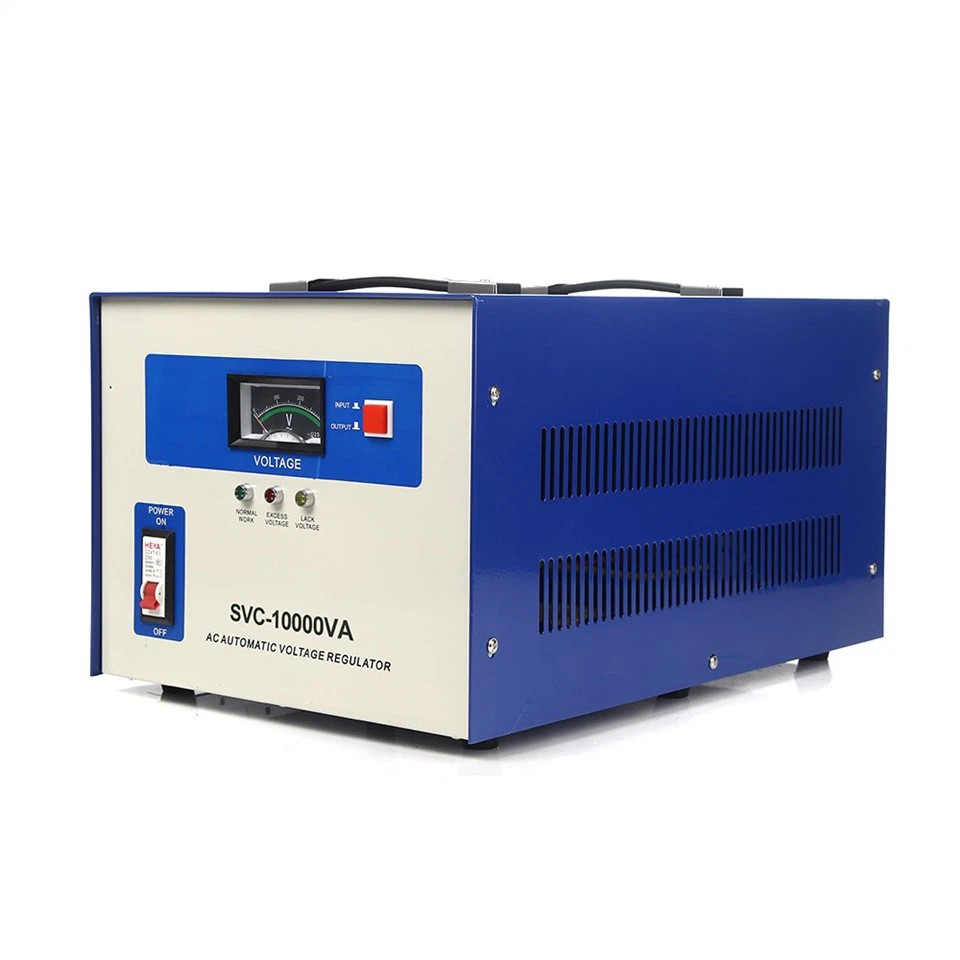
We offer a wide range of motor voltage regulators that utilize PWM technology. Our TND Single Phase Voltage Regulator is a popular choice for single - phase motor applications. It provides stable voltage control and can handle a variety of load conditions.
Our servo - type voltage regulators are designed specifically for servo motors, offering precise control of speed and position. Whether you're working on a small DIY project or a large industrial application, we have a motor voltage regulator that can meet your needs.
Contact Us for Procurement
If you're in the market for a motor voltage regulator, we'd love to hear from you. Our team of experts can help you choose the right product for your application and answer any questions you might have. Whether you need a high - performance servo motor voltage regulator or a reliable single - phase voltage regulator, we've got you covered. Don't hesitate to reach out and start a procurement discussion with us.
References
- Dorf, R. C., & Bishop, R. H. (2016). Modern Control Systems. Pearson.
- Chapman, S. J. (2012). Electric Machinery Fundamentals. McGraw - Hill.