



Hey there! As a supplier of Variac Variable Regulators, I often get asked about the difference between a Variac Variable Regulator and a regular transformer. So, I thought I'd write this blog to clear things up.
Let's start with the basics. A regular transformer is a device that transfers electrical energy between two or more circuits through electromagnetic induction. It has a primary winding and a secondary winding. The ratio of the number of turns in the primary winding to the number of turns in the secondary winding determines the voltage transformation ratio. For example, if the primary has 100 turns and the secondary has 50 turns, and you apply 100 volts to the primary, you'll get 50 volts at the secondary. It's a pretty straightforward device, mainly used to step up or step down the voltage in a fixed ratio.
On the other hand, a Variac Variable Regulator is a type of autotransformer. An autotransformer is a transformer with only one winding, which serves as both the primary and the secondary. The Variac Variable Regulator allows you to vary the output voltage continuously. You can adjust it to get a voltage anywhere from zero to a certain maximum value. This is super useful in a lot of applications where you need a variable voltage supply.
Construction Differences
The construction of a regular transformer and a Variac Variable Regulator is quite different. A regular transformer has two separate windings, usually wound on a laminated iron core. The primary winding is connected to the input voltage source, and the secondary winding is connected to the load. The windings are insulated from each other to prevent short - circuits.
In a Variac Variable Regulator, there's a single winding with a sliding contact. This sliding contact can move along the winding, changing the number of turns between the input and the output. As the contact moves, the output voltage changes. It's like having a variable voltage tap on a transformer.
Voltage Regulation
One of the biggest differences between the two is in voltage regulation. A regular transformer has a fixed voltage transformation ratio. Once it's designed and built, the output voltage is determined by the input voltage and the turns ratio. For example, if you have a step - down transformer with a ratio of 2:1, and the input is 220 volts, the output will always be 110 volts (ignoring small losses).

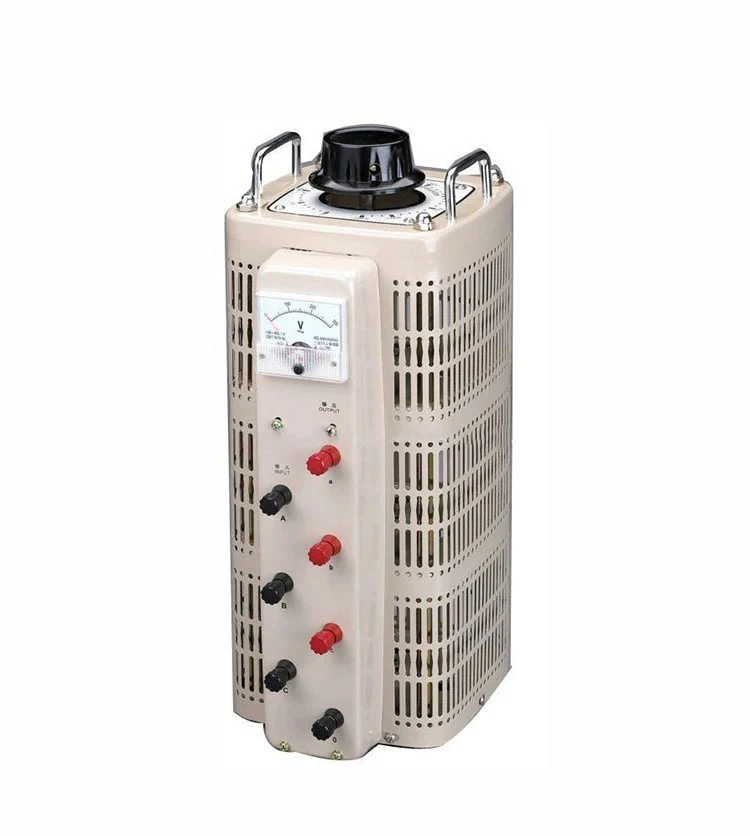
A Variac Variable Regulator, however, offers variable voltage regulation. You can adjust the output voltage according to your needs. This is extremely handy in laboratories, where you might need to test electronic components at different voltage levels. You can also use it in industrial settings to power equipment that requires a specific voltage that may change over time.
Applications
Regular transformers are used in many common applications. They're used in power distribution systems to step up the voltage for long - distance transmission (to reduce power losses) and then step it down for use in homes and businesses. They're also used in electronic devices like power supplies for computers, TVs, and other appliances.
Variac Variable Regulators have a different set of applications. In laboratories, they're used for testing electronic circuits, powering vacuum tubes, and simulating different voltage conditions. In industrial applications, they can be used to control the speed of motors, especially in situations where you need a variable speed. There are also Three Phase Variac Voltage Regulators for three - phase power systems, which are commonly used in large industrial machinery. And Single Phase Variac Voltage Regulators are used for single - phase applications like small workshops and some home appliances testing.
Efficiency
When it comes to efficiency, both regular transformers and Variac Variable Regulators have their pros and cons. A well - designed regular transformer can be very efficient, often reaching 95% or more efficiency. This is because the two - winding design allows for good magnetic coupling between the primary and the secondary.
The efficiency of a Variac Variable Regulator can vary depending on the output voltage setting. At lower output voltages, the efficiency may be lower because a larger portion of the winding is used as a voltage - dropping element. However, at higher output voltages, it can be quite efficient, similar to a regular transformer.
Safety Considerations
Safety is always an important factor. Regular transformers are generally considered safe because the two - winding design provides electrical isolation between the input and the output. This means that if there's a fault in the primary circuit, it's less likely to affect the secondary circuit.
In a Variac Variable Regulator, since it's an autotransformer, there's no electrical isolation between the input and the output. This means that the output voltage is directly related to the input voltage, and there's a risk of electric shock if not used properly. However, modern Variac Variable Regulators come with safety features like grounding and over - current protection to reduce these risks.
Cost
Cost is another aspect to consider. Regular transformers are mass - produced for standard applications, so they're usually more affordable. The manufacturing process for regular transformers is well - established, and there's a lot of competition in the market.
Variac Variable Regulators, on the other hand, are more expensive. The variable voltage feature requires more complex construction, and the sliding contact mechanism adds to the cost. But considering the flexibility they offer, the extra cost can be worth it in many applications.
Conclusion
So, in summary, a regular transformer is great for fixed - voltage applications. It's reliable, efficient, and widely available. But if you need a variable voltage supply, a Variac Variable Regulator is the way to go. It gives you the flexibility to adjust the output voltage as needed, which is very useful in a variety of applications.
Whether you're in a laboratory, an industrial setting, or just need a variable voltage source for a special project, a Variac Variable Regulator can be a valuable addition to your equipment. If you're interested in purchasing a Variac Variable Regulator, we offer both Three Phase Variac Voltage Regulators and Single Phase Variac Voltage Regulators. We have a wide range of products to suit your specific needs. Contact us to start a procurement discussion and find the best solution for you.
References
- Electrical Engineering textbooks on transformers and autotransformers
- Manufacturer's datasheets for regular transformers and Variac Variable Regulators