


Hey there! As a supplier of electronic voltage regulators, I often get asked about the difference between a voltage stabilizer and an electronic voltage regulator. It's a great question, and one that can be a bit confusing, especially if you're not too familiar with electrical systems. So, let's break it down and see what sets these two devices apart.
What's a Voltage Stabilizer?
A voltage stabilizer is like a safety net for your electrical equipment. Its main job is to keep the voltage supplied to your devices within a safe and stable range. You know how sometimes the voltage in your area can fluctuate? Maybe it spikes when a big appliance turns on or drops during peak usage times. These fluctuations can be really harmful to your sensitive electronics, like your TV, computer, or fridge.
A voltage stabilizer works by automatically adjusting the incoming voltage to a constant level. It does this using a combination of transformers, relays, and control circuits. When the input voltage is too high, the stabilizer reduces it to the desired level. And when it's too low, it boosts it up. This way, your devices always get the right amount of power, no matter what's going on with the supply.
For example, let's say you have a Lcd Stabilizer. If the voltage in your area suddenly jumps from 220V to 250V, the stabilizer will quickly step it back down to 220V, protecting your LCD TV from potential damage.
And What's an Electronic Voltage Regulator?
An electronic voltage regulator, on the other hand, is a more precise and high - tech device. It uses solid - state components like transistors, integrated circuits, and operational amplifiers to regulate the voltage. These components can respond much faster to voltage changes compared to the mechanical parts in a voltage stabilizer.
Electronic voltage regulators are often used in applications where very accurate voltage control is required. For instance, in a laboratory setting, where you're running sensitive experiments that rely on a stable power supply. Or in a computer's power supply unit, where even a small voltage variation can cause glitches or damage to the components.
There are different types of electronic voltage regulators, such as linear regulators and switching regulators. Linear regulators are simple and provide a very clean output voltage, but they're not very efficient, especially when there's a large difference between the input and output voltages. Switching regulators, on the other hand, are more complex but much more efficient. They work by rapidly switching the input voltage on and off and then filtering it to get the desired output voltage.
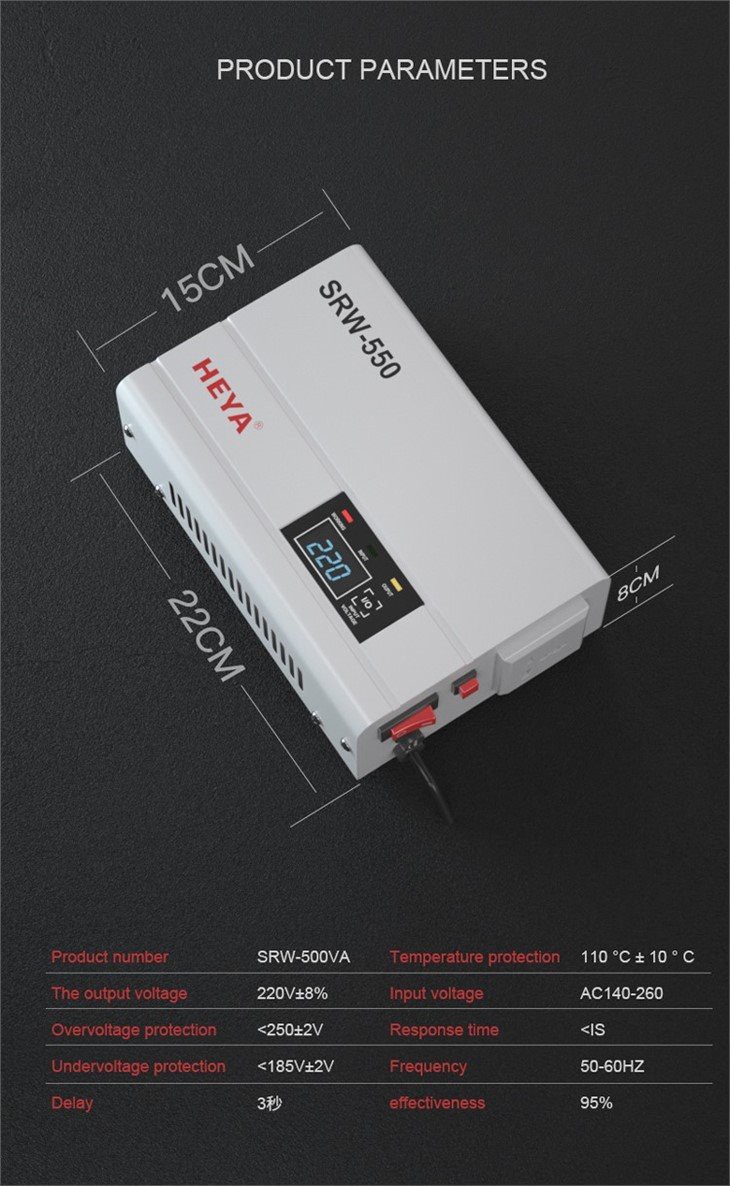

If you're looking for a portable solution, our Portable Voltage Regulator is a great option. It's small, lightweight, and can provide a stable voltage wherever you go.
Key Differences
Precision
One of the biggest differences between a voltage stabilizer and an electronic voltage regulator is the level of precision. Voltage stabilizers are good at keeping the voltage within a general range, say ±5% or ±10% of the desired value. But electronic voltage regulators can achieve much higher precision, often within ±1% or even less. This makes them ideal for applications where accuracy is crucial.
Response Time
Electronic voltage regulators have a much faster response time compared to voltage stabilizers. Since they use solid - state components, they can detect and correct voltage changes in a matter of microseconds. Voltage stabilizers, with their mechanical relays and transformers, take a bit longer to respond, usually in the range of milliseconds.
Efficiency
In terms of efficiency, electronic voltage regulators, especially switching regulators, are generally more efficient than voltage stabilizers. Voltage stabilizers often waste some energy as heat, especially when there's a large difference between the input and output voltages. Electronic switching regulators can convert the input voltage to the output voltage with very little energy loss, which means less heat generation and lower electricity bills in the long run.
Cost
Cost is also a factor to consider. Generally, voltage stabilizers are less expensive than electronic voltage regulators. This is because they use simpler technology and fewer high - tech components. However, for applications where precision and efficiency are important, the extra cost of an electronic voltage regulator is often worth it.
Applications
Voltage Stabilizers
Voltage stabilizers are commonly used in homes and small businesses to protect appliances from voltage fluctuations. They're great for things like refrigerators, air conditioners, and washing machines. These devices can tolerate a certain amount of voltage variation, but over time, repeated fluctuations can cause wear and tear on their components. A voltage stabilizer helps to extend their lifespan.
Electronic Voltage Regulators
Electronic voltage regulators are used in a wide range of high - tech applications. In the automotive industry, they're used to regulate the voltage in the car's electrical system, ensuring that the sensitive electronics like the engine control unit and the infotainment system get a stable power supply. In the aerospace and telecommunications industries, they're used in satellites, cell towers, and other critical equipment where reliable and precise voltage regulation is essential.
Why Choose Our Electronic Voltage Regulators?
As a supplier of electronic voltage regulators, we take pride in offering high - quality products. Our Ac AVR is designed to provide stable and accurate voltage regulation for a variety of AC applications. It's built with the latest technology and undergoes rigorous testing to ensure its performance and reliability.
We understand that every customer has different needs, and that's why we offer a range of products to choose from. Whether you need a small, portable regulator for a DIY project or a large - scale regulator for an industrial application, we've got you covered.
Our team of experts is always ready to help you find the right product for your specific requirements. We can provide technical support and advice to make sure you get the most out of your voltage regulator.
Time to Make a Decision
If you're still not sure whether a voltage stabilizer or an electronic voltage regulator is right for you, think about your specific needs. If you just need basic protection for your home appliances against voltage fluctuations, a voltage stabilizer might be sufficient. But if you're working on a high - tech project that requires precise voltage control, an electronic voltage regulator is the way to go.
If you're interested in purchasing an electronic voltage regulator, we'd love to hear from you. We can discuss your requirements in detail and help you find the perfect solution for your needs. Don't hesitate to reach out and start a conversation about your procurement needs.
References
- "Electric Circuits" by James W. Nilsson and Susan A. Riedel
- "Power Electronics: Converters, Applications, and Design" by Ned Mohan, Tore M. Undeland, and William P. Robbins