


Hey there! As a supplier of industrial voltage stabilizers, I often get asked about how these nifty devices work. So, today, I'm gonna break down the working principle of a servo - controlled industrial voltage stabilizer for you.
Basics of Voltage Stabilization
First off, let's talk about why we even need voltage stabilizers. In industrial settings, electrical equipment is super sensitive to voltage fluctuations. A sudden spike or drop in voltage can mess up the performance of machines, cause malfunctions, and even lead to permanent damage. That's where voltage stabilizers come in. They ensure that the voltage supplied to the equipment remains within a safe and stable range.
What's a Servo - Controlled Industrial Voltage Stabilizer?
A servo - controlled industrial voltage stabilizer is a type of voltage regulator that uses a servo motor to control the output voltage. It's widely used in industries because it can handle large loads and provide accurate voltage regulation.
The Key Components
Before we dive into the working principle, let's take a look at the main components of a servo - controlled industrial voltage stabilizer:

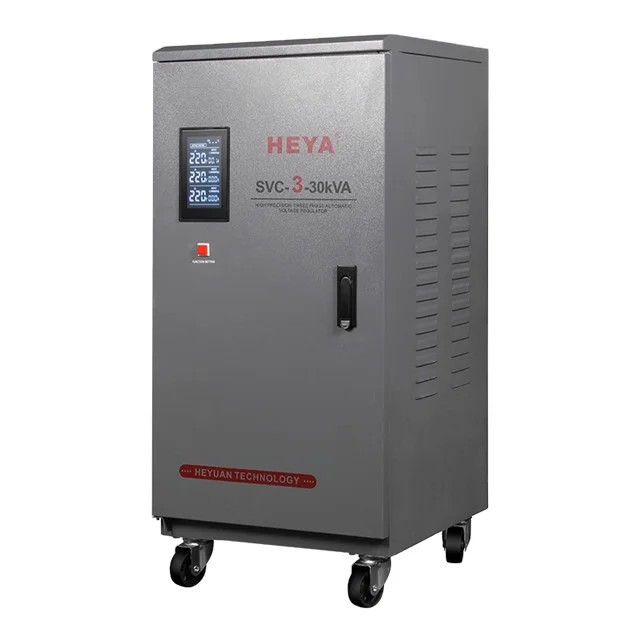
- Auto - transformer: This is the heart of the stabilizer. It's a special type of transformer that can vary its output voltage by changing the number of turns in the coil.
- Servo motor: The servo motor is responsible for adjusting the position of the tap on the auto - transformer. It moves based on the feedback it receives about the output voltage.
- Voltage sensor: This component continuously monitors the output voltage of the stabilizer. It sends the voltage information to the control circuit.
- Control circuit: The control circuit analyzes the voltage data from the sensor. If the output voltage is outside the desired range, it sends a signal to the servo motor to make the necessary adjustments.
How It Works
Now, let's get into the nitty - gritty of how a servo - controlled industrial voltage stabilizer actually works.
Step 1: Monitoring the Voltage
The voltage sensor constantly keeps an eye on the output voltage of the stabilizer. It measures the voltage and sends this information to the control circuit. For example, if the ideal output voltage is supposed to be 220V, the sensor will detect if the actual voltage is higher or lower than this value.
Step 2: Analyzing the Data
Once the control circuit receives the voltage data from the sensor, it compares it with the pre - set reference voltage. If the output voltage is different from the reference voltage, the control circuit calculates the amount of adjustment needed.
Let's say the output voltage is 230V, but the reference voltage is 220V. The control circuit will figure out that the voltage needs to be decreased by 10V.
Step 3: Sending the Signal
Based on the calculation, the control circuit sends a signal to the servo motor. This signal tells the servo motor which direction to move and how far to turn. In our example, the signal will instruct the servo motor to adjust the tap on the auto - transformer in a way that reduces the output voltage.
Step 4: Adjusting the Auto - Transformer
The servo motor then moves the tap on the auto - transformer according to the signal it received. By changing the position of the tap, the number of turns in the coil of the auto - transformer is altered. This, in turn, changes the output voltage.
If the servo motor moves the tap to a position with fewer turns, the output voltage will decrease. Conversely, if it moves the tap to a position with more turns, the output voltage will increase.
Step 5: Re - checking the Voltage
After the adjustment is made, the voltage sensor checks the output voltage again. It sends the new voltage data to the control circuit. If the output voltage is still not within the desired range, the whole process repeats until the voltage stabilizes at the correct value.
Advantages of Servo - Controlled Industrial Voltage Stabilizers
There are several reasons why servo - controlled industrial voltage stabilizers are so popular in the industry:
- High accuracy: They can regulate the voltage with a high degree of precision, usually within ±1% to ±3% of the set voltage. This is crucial for sensitive industrial equipment that requires a stable power supply.
- Fast response time: These stabilizers can quickly detect and correct voltage fluctuations. In a matter of seconds, they can adjust the output voltage to the desired level, minimizing the risk of damage to the equipment.
- Large load capacity: Servo - controlled stabilizers can handle high - power loads, making them suitable for industrial applications where multiple machines are running simultaneously.
Applications
Servo - controlled industrial voltage stabilizers are used in a wide range of industries, including:
- Manufacturing: In factories, where machines like CNC routers, injection molding machines, and automated assembly lines need a stable power supply to operate efficiently.
- Data centers: To protect servers and other critical IT equipment from voltage variations that could lead to data loss or system failures.
- Healthcare: In hospitals, Medical Ac Stabilizer are used to ensure the proper functioning of medical equipment such as MRI machines, X - ray machines, and ventilators.
Other Types of Voltage Stabilizers
While servo - controlled stabilizers are great, there are also other types of voltage stabilizers available in the market. For example, Industrial 3 Phase Voltage Stabilizer are designed to handle three - phase power systems, which are commonly used in industrial settings. And TNS Three Phase Voltage Regulator offer another option for regulating three - phase voltage.
Why Choose Us?
As an industrial voltage stabilizer supplier, we offer high - quality products that are built to last. Our servo - controlled industrial voltage stabilizers are designed with the latest technology to provide accurate and reliable voltage regulation. We also offer excellent customer service, so if you have any questions or need help with installation and maintenance, our team is here to assist you.
If you're in the market for an industrial voltage stabilizer, whether it's a servo - controlled one or another type, don't hesitate to reach out to us. We can help you find the right solution for your specific needs. Contact us today to start the procurement process and let's work together to ensure a stable power supply for your business.
References
- Electrical Engineering Handbook, Third Edition
- Industrial Power Systems Handbook