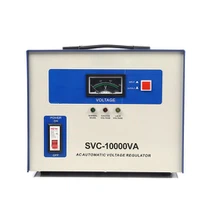
1. How to use the non-contact motor regulator?
First of all, according to the power of the non-contact motor voltage stabilizer purchased, it can be calculated at 0.75 square millimeter per kilowatt, and suitable wires are selected to connect the input and output of the non-contact motor voltage stabilizer.
Note: The wiring must be strictly in accordance with the wiring mark of the non-contact motor regulator during installation, and cannot be omitted or connected incorrectly. Pay special attention to that the live wire and the neutral wire cannot be reversed, the neutral wire and the ground wire cannot be confused, and the ground wire and the neutral wire Cannot be omitted. Turn on the switch of the non-contact motor voltage stabilizer, the LCD display on the panel displays the voltage, indicating that the non-contact motor voltage stabilizer has been working normally.
2. Safety device of non-contact motor voltage stabilizer:
The non-contact motor voltage stabilizer below 3KVA uses a fuse for overload or short circuit protection, and the AC non-contact motor voltage stabilizer above 5KVA uses a small circuit breaker or a small air switch as overload or short circuit protection. It works in the non-contact motor voltage stabilizer. If the fuse is blown or the automatic air circuit breaker trips, the load and the non-contact motor regulator should be shut down and checked.
3. Overvoltage protection of non-contact motor voltage stabilizer:
When the output voltage exceeds the protection value of the non-contact motor voltage stabilizer (the phase voltage protection value is adjusted to 15V when leaving the factory), the non-contact motor voltage stabilizer will automatically protect, reduce or cut off the output voltage of the non-contact motor voltage stabilizer, and at the same time The display shows an overvoltage indication, and the user should immediately shut down and check the grid voltage or contactless motor regulator.