


In the modern household, electrical appliances are the cornerstone of our daily comfort and convenience. From the refrigerator that keeps our food fresh to the air conditioner that cools us down on sweltering days, these devices rely on a stable power supply to function properly. However, the electrical grid is not always a reliable source, and voltage fluctuations, including short - circuits, can pose significant threats to our appliances. This is where a household voltage regulator steps in as a crucial guardian. As a household voltage regulator supplier, I am here to delve into how these regulators protect against short - circuits.
Understanding Short - Circuits
Before we explore how voltage regulators protect against short - circuits, it's essential to understand what a short - circuit is. A short - circuit occurs when an unintended low - resistance connection is made between two points in an electrical circuit. This can happen due to a variety of reasons, such as damaged wiring, loose connections, or electrical component failure. When a short - circuit happens, an extremely high current flows through the circuit, far exceeding the normal operating current. This excessive current can cause overheating, damage to electrical components, and even start an electrical fire.
Core Protection Mechanisms of a Household Voltage Regulator
1. Current Sensing
One of the primary ways a household voltage regulator protects against short - circuits is through current sensing. Inside the voltage regulator, there are sophisticated current sensors. These sensors continuously monitor the current flowing through the regulator. Under normal operating conditions, the current remains within a specific range that is appropriate for the connected appliances. However, when a short - circuit occurs, the current surges dramatically.
As soon as the current sensors detect this abnormal increase in current, they send a signal to the control unit of the voltage regulator. The control unit is the "brain" of the regulator, responsible for processing the information received from the sensors and taking appropriate actions.
2. Circuit Interruption
Upon receiving the signal from the current sensors indicating a short - circuit, the control unit activates the circuit interruption mechanism. This mechanism is designed to quickly cut off the electrical connection between the power source and the connected appliances.
In many household voltage regulators, this is achieved through the use of relays. Relays are electrical switches that can be controlled electronically. When the control unit detects a short - circuit, it sends a signal to the relay, causing it to switch from the closed state (allowing current flow) to the open state (breaking the circuit). This rapid interruption of the circuit prevents the high - current caused by the short - circuit from reaching the connected appliances, thereby protecting them from damage.
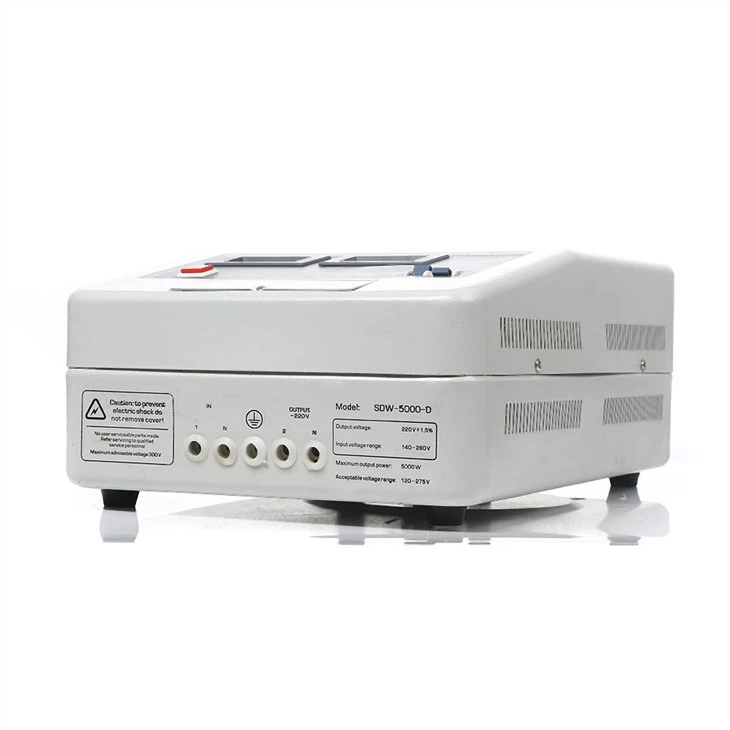

Different Types of Voltage Regulators and Their Short - Circuit Protection
Fully Automatic AC Voltage Regulator
A Fully Automatic AC Voltage Regulator is a highly advanced type of voltage regulator commonly used in households. It offers comprehensive protection against various voltage problems, including short - circuits.
These regulators use advanced microprocessor - based control systems to monitor and regulate the voltage. In addition to the basic current sensing and circuit interruption mechanisms, fully automatic AC voltage regulators can also adjust the output voltage in real - time. When a short - circuit occurs, they can quickly detect the abnormal current and not only cut off the power but also perform self - diagnostics to identify the cause of the short - circuit. This self - diagnostic feature can be very useful for maintenance and troubleshooting.
Relay Type Stabilizer
Relay Type Stabilizer is another popular type of voltage regulator. It uses a series of relays to adjust the output voltage. In terms of short - circuit protection, the relay type stabilizer relies on its relay - based circuit interruption mechanism.
When the current sensors detect a short - circuit, the control unit of the relay type stabilizer sends a signal to the relays. The relays then open the circuit, stopping the flow of excessive current. One of the advantages of relay type stabilizers is their simplicity and reliability. They are relatively inexpensive and can provide effective protection against short - circuits in most household applications.
Voltage Regulator for Fridge
A Voltage Regulator for Fridge is specifically designed to protect refrigerators from voltage fluctuations and short - circuits. Refrigerators are sensitive appliances, and a short - circuit can cause serious damage to their compressors and other components.
These voltage regulators are equipped with precise current sensing and protection mechanisms. They are designed to respond quickly to short - circuits and ensure that the refrigerator is disconnected from the power source before any damage occurs. In addition, they may also have features such as over - voltage and under - voltage protection to provide comprehensive protection for the refrigerator.
Additional Protection Features
Thermal Protection
In addition to current sensing and circuit interruption, many household voltage regulators also have thermal protection features. When a short - circuit occurs, the high current can cause the components inside the regulator to heat up rapidly. If the temperature rises too high, it can damage the regulator itself.
Thermal sensors are installed inside the voltage regulator to monitor the temperature. If the temperature exceeds a safe limit, the thermal protection mechanism will be activated. This can involve either reducing the load on the regulator or cutting off the power completely to prevent further overheating.
Surge Protection
Short - circuits can sometimes be accompanied by voltage surges. A voltage surge is a sudden increase in voltage that can cause damage to electrical appliances. Many household voltage regulators are equipped with surge protection devices, such as metal - oxide varistors (MOVs).
MOVs are designed to conduct current when the voltage exceeds a certain level. When a voltage surge occurs due to a short - circuit, the MOVs in the voltage regulator will start to conduct, diverting the excess voltage away from the connected appliances. This helps to protect the appliances from the damaging effects of voltage surges.
Contact Us for Purchase
As a household voltage regulator supplier, we understand the importance of protecting your valuable electrical appliances from short - circuits and other voltage problems. Our range of voltage regulators, including fully automatic AC voltage regulators, relay type stabilizers, and voltage regulators for fridges, are designed to provide reliable and efficient protection.
If you are interested in purchasing our voltage regulators or have any questions about our products, please feel free to contact us. We are more than happy to assist you in finding the right voltage regulator for your specific needs.
References
"Electrical Engineering Handbook", edited by Richard C. Dorf.
"Power Electronics: Converters, Applications, and Design" by Ned Mohan, Tore M. Undeland, and William P. Robbins.