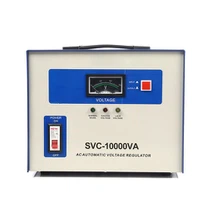




Driven by core areas such as industrial automation, new energy sources and data centers, global electricity demand continues to grow and the requirements for power quality are becoming more stringent. Voltage fluctuations will not only cause equipment efficiency to decrease, lifespan to shorten, but also cause production interruptions, data loss and other serious consequences. With its unique electromechanical coordination and regulation mechanism, the Contact-type voltage stabilizers has demonstrated remarkable advantages in the fields of high efficiency, energy conservation and environmental protection, and has become the core guarantee for the stable operation of modern power system.
I. Technological Innovation: from Traditional Machinery to smart green
The core of the contact-stabilized voltage regulator lies to dynamically adjust the output voltage through the sliding of carbon brushes on the winding of the autotransformer. The working process is divided into three steps: voltage detection, mechanical adjustment and feedback closed-loop control. When input voltage fluctuates, the built-in sampling circuit monitors it in real time, drives the servo motor to slide the carbon brush, changes the position of the transformer tap, and finally verifies and corrects the output voltage through the feedback circuit, forming the closed loop control. Although the process relies on mechanical contact, through technological upgrading, the breakthrough of high efficiency, energy conservation and intelligence has been achieved.
1.Efficient energy saving: Double Optimization of Materials and Circuits
Traditional contact regulator has efficiency bottlenecks due to mechanical contact friction and carbon brush wear. The new generation of products has greatly improved energy efficiency through material upgrades and circuit optimizations
Anaerobic copper coils and Low Loss Copper Core: With 99.97% oxygen-free copper coils and low loss copper core, the energy efficiency of the product increases to over 95%, reducing annual power consumption by 15% to 20% compared to traditional models. For example, the application of an electronics factory could saved 12,000 kilowatt hours of electricity per year, equivalent to about 9.8 tons of carbon emissions.
Intelligent power factor compensation: Some contact-type voltage stabilizers integrate reactive power compensation functions. By dynamically adjusting the capacitor bank, the power factor can be increased from 0.7 to more than 0.95 and the passive power loss can be reduced. The application of a medium-sized machinery factory resulted in a 12% reduction in the annual electricity bill, while avoiding fines from the power supply department for non-compliance with the power factor criteria.
2.Green and environmental protection: sustainable transformation of materials and processes
contact voltage stabilizer manufacturers are embracing eco-friendly materials and processes, driven by 'dual carbon' goals
Lead Free Welding and Recyclable Shells: Scrap lead welding for lead free solder to reduce heavy metal pollution; use recyclable plastic or metal shells to reduce the environmental impact of waste. For example, the export market share of a manufacturer whose products had been certified by the European Union RoHS had increased by 20%.
Low noise, low EMI design: by optimizing mechanical structures and electromagnetic shielding, operating noise is controlled below 50 decibels, the effects of electromagnetic radiation on surrounding equipment are reduced, and strict standards for green data centers and medical facilities are met.
ii. Application Scenarios: From Industrial Manufacturing to people's livelihood security
Contact-type voltage stabilizers is widely used in manufacturing, medical treatment, new energy and so on, because of its high cost efficiency and wide adaptability.
1. Industrial manufacturing: a core tool for cost reduction and efficiency
In precision manufacturing scenarios, voltage fluctuations can lead to an increase in equipment failure rate and a decrease in yield rates. Contact voltage stabilizer reduces production cost greatly by stabilizing voltage.
CNC machine tools and automatic production line: after a stamping workshop adopted a voltage stabilizers, servo presses bus voltage drop from 12% to less than 5%, the robot controllers reset frequency decreases by 90%, and the production cycle extends by 15%.
Injection molding and metal processing: after the application of a stabilizer voltage stabilizers a plastic products factory, the injection molding cycle was shortened by 8%, power consumption per unit of product was reduced by 10%, and the electricity cost savings is saved by more than half a million yuan annually.
2. In the field of health care: life Guardianss
Medical devices require very high voltage stability. Even small fluctuations can affect diagnosis or treatment safety. Contact regulator provides "zero-tolerance" voltage protection for medical devices:
Imaging equipment and Life Monitoring System: After the deployment of voltage voltage stabilizers in Level III hospitals, the failure rate of CT, MRI and other equipment due to voltage fluctuations decreased from 3 to 0 times per month, reducing downtime losses by more than $2 million per year.
Operating theatre and ICU: In areas with a concentration of voltage sensitive equipment, voltage stabilizers control output voltage fluctuation to ±0.5% to ensure stable operation of surgical instruments and monitors.
3. New Energy and Distributed Power Grids: Building blocks for Stable grid connection
The randomness and impact loads of new energy generation can easily lead to overvoltage and threaten the safety of power supply. Contact-type voltage stabilizers ensure efficient utilization of new energy sources through extensive voltage regulation and harmonic suppression
Photovoltaic energy storage system: When a photovoltaic power station adopted a voltage a voltage stabilizer, the input voltage range was expanded to 304V-456V. Combined with the harmonic suppression module, the charging efficiency of the energy storage battery increased from 65% to 92%.
Offshore Aquaculture mining area power supply: At the end of the rural power grid, where the power supply radius exceeds the limit, the voltage stabilizer works dynamically at 10.2kV±2%, eliminating low voltage bottlenecks and ensuring uninterrupted operation of the oxygenation system and mining equipment.
Iii. Future trends: Smart, customization leads the transition.
With the popularization of Internet of Things, big data, and artificial intelligence, contact voltage regulators are moving from "passive voltage regulation" to "active management," ushering in a new era of green voltage regulation.
1. Intelligent upgrade: upgrade from a single machine to a system.
Mainstream manufacturers realize remote monitoring and fault warning by integrating intelligent operation module.
Remote monitoring and data analysis: A certain manufacturer's voltage stabilizer supports the collection of data such as voltage fluctuations and load states over Ethernet. Combined with fault warning algorithm, the response efficiency of operation dimension is improved by 40%.
Dynamic PID dual-loop control: Even if the load is suddenly increased from 20% to 90%, the output voltage is stable in the range of 380V±1% through a coordinated voltage and current regulation, suitable for applications with high power quality requirements such as semiconductor manufacturing.
2. Customized services: from general to scene adaptation
According to the grid characteristics and load requirements of different industries, manufacturers have introduced customization solutions:
In the field of new energy: development of a wide range of photovoltaic inverters voltage regulation products, input voltage range of 300V to 460V, to adapt to changes in light intensity.
Severe Environmental Applications: In high temperature and humidity environment such as metallurgy and chemical industry, an IP44 protection level design and anticorrosive coating are used to ensure continuous operation of equipment in high temperature environment of 45 degrees Celsius and 80% humidity.
Conclusion:
Contact-type voltage stabilizers has become core equipment of modern power system through technological innovation and scenario adaptation. Its high efficiency and energy saving features help enterprises reduce costs and improve efficiency. Its green design responds to the "dual carbon" goals, and its intelligent and customized services meet diverse needs. In the future, with the deepening of industrial intelligence and energy transformation, contact-type voltage stabilizers will be upgraded from ``supplier of power equipment "to ``supplier of power quality solutions' ', providing core support for the green and stable operation of the global power system.