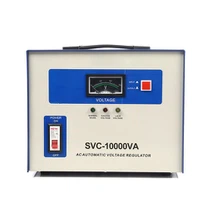



The main reason of voltage regulator temperature compensation is that the electrical parameters of electronic components vary with temperature, which affects the accuracy and stability of voltage regulation. Temperature compensation technology can reduce the influence of temperature on the performance of the components and ensure stable output voltage of the voltage regulator in the range of ambient temperature. Here are some details:
I. Effects of temperature on Key Components of Voltage Regulators
Electrical parameters of key components of a voltage regulator,such as resistors, capacitors, diodes, and transistors, drift with temperature, causing the output voltage to deviate from the set value. Specific manifestations are as follows:
Resistance change
The temperature coefficient of resistor of the metal film was ± 100 ppm/ oC (i.e. 0.01% change in resistance for every 1°C change in temperature).
For example, when the temperature rises by 50°C, the 100 Omega resistor may change + -500 Omega, directly affecting the output voltage voltage of the divider circuit.
Diode Forward Voltage Drop Change
The positive voltage drop of the silicon diode decreases with increasing temperature, usually -2 mV/ oC.
For example, in a reference voltage circuit, if the diode voltage drop drops from 0.7V to 0.6V, the output voltage drops by approximately 14%.
Transistor Parameter Drift
Parameters such as transistors' current gain (beta) and basal emission voltage (Vbe) are sensitive to temperature.
For example, for every 1°C increase in Vbe, there is a reduction of about 2 mV, which may result in a shift in the transistor's working point, affecting the gain and stability of the amplifier circuit.
Capacitor Value Change
The capacitance of electrolytic capacitor increases with temperature and the the capacitance of ceramic capacitor decreases with temperature.
This capacitance change will affect the cutoff frequency of the filter circuit and cause the output voltage ripple to increase.
ii. The Necessity of Temperature Compensation
Without a temperature compensating voltage regulator, temperature variations can cause the following problems:
Output Voltage Offset
For example, in an automotive alternator regulator, if the reference voltage decreases due to temperature rise, the output voltage of the alternator may not be sufficient to charge the battery, leading to battery depletion.
Reduced Regulation Accuracy
In precision instruments (such as medical equipment and laboratory power supplies), temperature-induced voltage fluctuations may exceed the allowable margin of error, affecting device performance or experimental results. System Stability risk
Changes in temperature can cause the regulator to enter a a a nonlinear working area, causing oscillation, instability and even damage of the load device.
Reduced Lifespan
Long-term temperature drift will lead to stress accumulation of components, accelerate aging, and shorten the regulator's lifespan.
III. Temperature Compensation method
Voltage regulators uses the following techniques to achieve temperature compensation:
1. Hardware Compensation
(1) Thermistor Compensation
In a divider circuit, a series of thermal resistors with negative temperature coefficient. Its resistance decreases as the temperature increases, compensating for the temperature drift of other resistors.
For example, in a reference voltage circuit, the NTC resistor is serialized with a a fixed resistor to ensure that the total resistance remains stable during temperature changes.
(2) Diode Compensation.
The negative temperature coefficient of the diode (about -2mV / oC) is used to compensate for the temperature drift the transistor's Vbe.
For example, in a bandgap reference circuit, by carefully designing the current ratio between two diodes, the output voltage remains almost constant with temperature.
(3) Integrated Temperature Compensation Circuit
temperature sensor and compensation network are integrated into specialized voltage regulator chip (e.g. LM7805 and LM317 to automatically adjust the output voltage.
For example, The LM317 uses an internal operational amplifier and transistor circuit to achieve output voltage temperature coefficient below 50 ppm / oC.
2. Software Compensation (Digital Regulation)
(1) Temperature Sensor sampling.
Real-time monitoring of ambient or component temperature using digital temperature sensor such as DS 18B20.
(2) Microcontroller Correction
According to temperature data, dynamic adjustment of PWM output PWM voltage to make the PWM duty ratio or digital potentiometer resistance calculation method.
For example, in switching power, microcontrollers adjust feedback loop parameters based on temperature feedback to maintain output voltage stable.
IV. INTRODUCTION Typical Application Scenarios
Automotive Electronics
Engine compartment can be between -40C and 125C. Voltage regulators require temperature compensation to ensure stable alternator output voltage and prevent overcharging or overcharging of batteries.
Industrial control
In factory environments, temperature fluctuations will affect the voltage of PLC, sensor and so on, Temperature compensation can improve the reliability of the system. Communication Equipment
Base station equipment needs to operate steadily at temperatures between minus 40 and 55 degrees Celsius. Temperature compensation can prevent communication interruptions caused by voltage fluctuations.
Renewable Energy Systems
Voltage regulators for photovoltaic inverters and wind power converters must adapt to variations in outdoor temperature to ensure efficient energy conversion.
V. Selection and Design Recommendations
Choose a model with Temperature Compensation
Thermostats with temperature factors (e.g. ±0.01%/°C) or integrated temperature compensation chips are preferred.
Verify Compensation Performance
High/low temperature tests (-40°C to 85°C) are conducted to verify the stability of the output voltage stability and ensure that it meets application requirements.
Consider Heat Dissipation Design
Optimize component layout, increase heat sinks or fan, reduce component temperature rise, minimize temperature compensation burden.
Combining digital and Analog Approaches
In complex systems, high precision temperature compensation is achieved by combining hardware compensation and software calibration.